Fundraising
$1M+
Kai John-Blunch · Product manager

I am a Pier cofounder. In our three-person team, I lead product work: customer research, workflow definition, onboarding design, roadmap decisions, quality assurance, and engineering priorities.
Pier builds AI-assisted tools for qualification and evaluation work. Users can review interview information and workflow inputs before they make a decision. I led more than 100 customer conversations and user interviews. I built the process that carried what we learned into product, market-positioning, and engineering decisions.
Fundraising, customer research, and pilot partnerships at a three-person startup.
At Pier, fundraising, customer research, and product delivery all affected the same small team. I prepared investor materials and financial analysis, then pitched investors during the raise. The case studies show how I used customer research to make product decisions.
Fundraising
$1M+
User and customer discovery
100+
Partner commitment
2
Selected product work
These cases show employer onboarding, customer research, and a revised pilot test.
Product episode
Pier lets employers create an opening, invite candidates to an AI-assisted interview, and review the evaluation before making a hiring decision. I defined signup requirements, designed the flow and error states, worked with engineering, and tested the experience before release.
Result: released onboarding and partner guidance that matched the paths I tested.
Open case studyProduct episode
Across more than 100 customer conversations and user interviews, I designed and ran a process that turned transcripts into findings the technical cofounder could trace to the source and use in product decisions.
Result: a repeatable research process for product, positioning, and MVP feature decisions.
Open case studyProduct episode
When pilot-partner responses stalled, I asked a trusted friend and a strategic advisor to test the employer setup and share flow. Their feedback changed our roadmap, engineering work, and product positioning.
Result: we used feedback from two outside testers to make specific product decisions while pilot-partner testing remained separate.
Open case studyWider proof library
Compare roadmap decisions, customer research, workflow design, team coordination, and launch learning across five case studies.
Choose a skill to see how I applied it at Pier. Each view highlights a different part of the same five projects.
Choose a skill
Lens in focus
Roadmap and prioritization
Case study · Roadmap Shaping Through Product Evidence
I used customer research to plan the launch: small-business positioning, candidate value, website copy, and MVP scope.
Choose the research that can change the launch plan.
Open case studyCase study · Changing The Test Path When Pilot Signal Stalled
After SmartApply shipped, I used what partners could try and trust to plan demos, follow-up, and the next build priority.
Use pilot feedback to update the next build decision.
Open case studyCase study · Building A Customer-Intelligence Learning Loop
I turn user interviews into findings we can use to choose the next build priorities.
Use discovery to change the roadmap.
Open case studyCase study · Testing A Construction Workflow Thesis
I narrowed broad procurement language into a specific subcontractor-activation workflow we could test without overclaiming.
Prioritize the workflow specific enough to test.
Open case studyCase study · Daily Agile Rituals And Team Coordination
In team check-ins, we assigned an owner, next action, due date, and follow-through for each priority.
Turn priority decisions into assigned work.
Open case studyWriting
Essay · June 5, 2026
An essay about AI services, insurance claims, and who gets to define completed work.
Read essayEssay · June 4, 2026
An essay about AI as a production system: who owns the tools that shape thought work, what happens to human skill, and why concentration and access have to be understood together.
Read essayAgent workflow
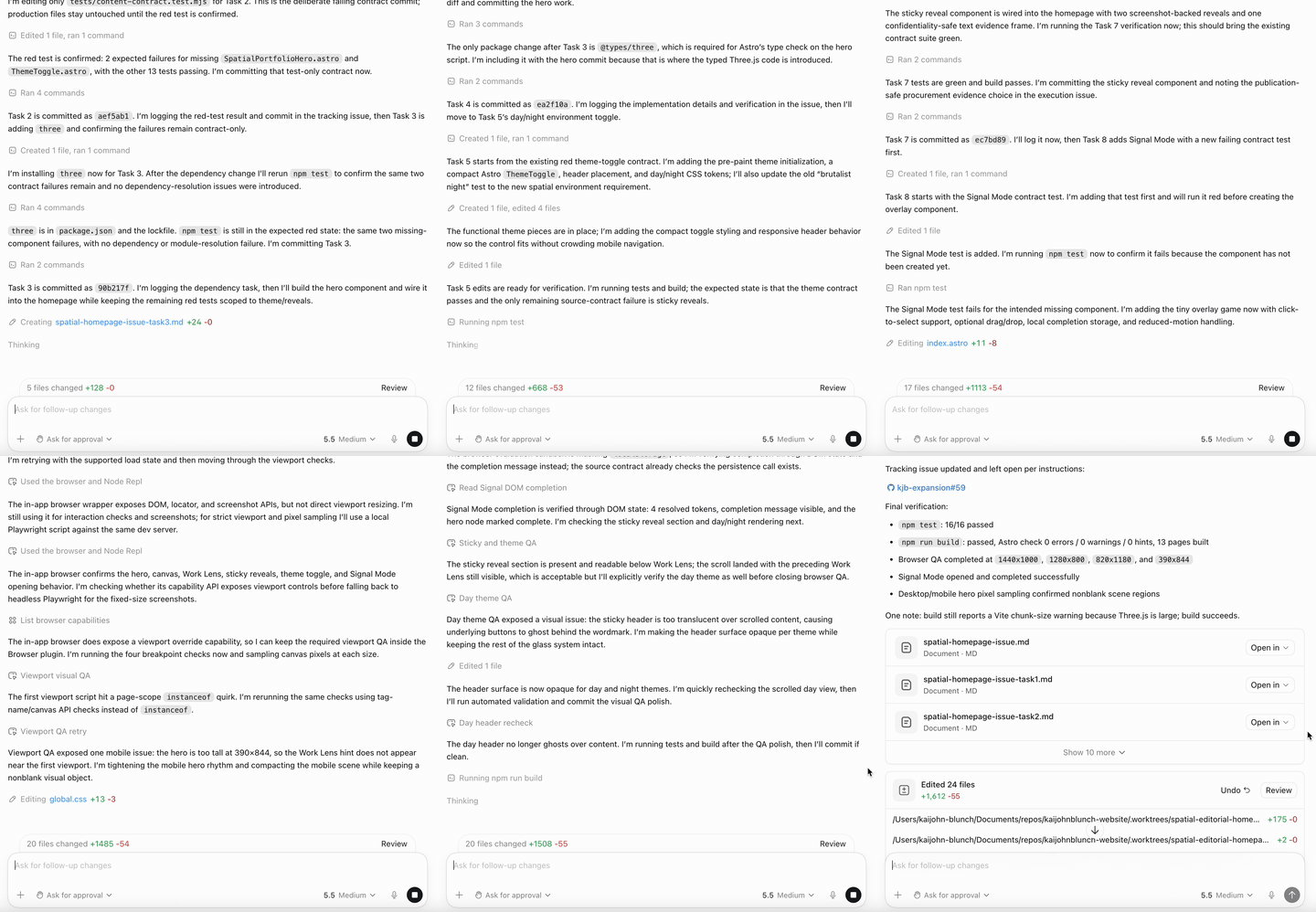
A sped-up recording of the workflow: the agent reads the plan, executes a task, updates the tracker, verifies against the requirements, and repeats that loop until the work is complete. Only then does it open the PR.